Rockbridge Academy Blog
The Four Vocations: A Call to Serve
November 19, 2026
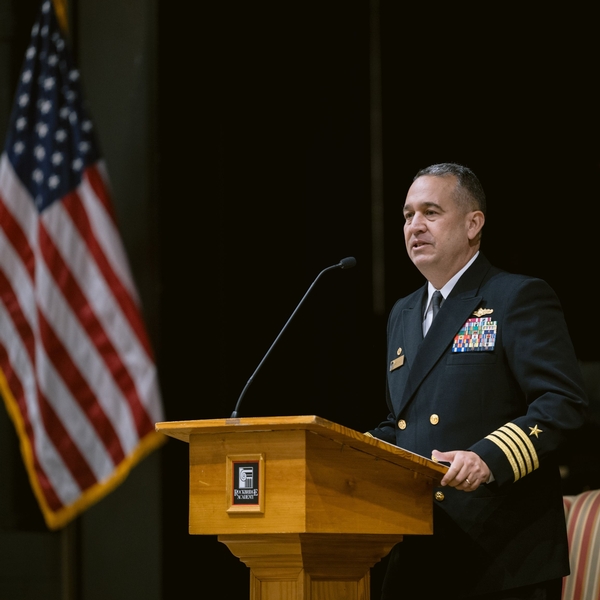
Some of you may recognize my title as a respectful borrowing from C.S. Lewis's wonderful book, The Four Loves. In that classic, Lewis wrote about the four distinct types of love that shape our lives. This morning, I would like to talk about four callings that shape our lives, four arenas in which God calls each of us to serve. Before anything else, however, we should begin where Veterans Day always begins: with gratitude.
To the veterans among us today, thank you. Thank you for your willingness to place duty ahead of comfort. Thank you for your sacrifices — and those of your families. Thank you for the birthdays missed, the holidays interrupted, the uncertainty endured, and the burdens you carried so that others might live in peace, comfort and freedom. And to the spouses, parents, children, and grandparents who served alongside those veterans in ways often unseen, thank you as well.
We honor all of you today.
But Veterans Day is not only a day of gratitude. It is also a day of instruction. When we honor veterans, we should ask a question: What can we learn from the lives they chose to live? I believe the answer to that question connects beautifully with the Scripture passage that is part of today's program. In Jeremiah 31, God speaks to His people about restoration and renewal. He promises a day when His law will not merely be written on tablets of stone but written upon their hearts. God's concern is not merely for external obedience. His concern is the formation of character. He is shaping a people who love what is good, who desire what is right, and who willingly embrace their responsibilities before God — and their neighbor. In other words, He is shaping servants.
And that matters because we live in a culture that often points us in the opposite direction.
Much of the world teaches us to ask: "What am I owed?" Scripture teaches us to ask: "Whom can I serve?" This difference changes everything. Entitlement asks, "What should others do for me?" Service asks, "What can I do for others?" Entitlement focuses on self-while downplaying or ignoring responsibilities. Service embraces the idea that blessings and responsibilities belong together. To put it bluntly: Entitlement weakens communities. Service builds them.
And one of the reasons we gather on Veterans Day is because military service stands as a powerful rejection of entitlement. Because Veterans are those who have voluntarily raised their right hand and committed themselves to something greater than their personal comfort.
They accept obligations. They embrace responsibility. They choose service. And while not everyone is called to military service, every Christian is called to a life of service.
Each of us has what we might call The Four Vocations. Four callings. Four arenas in which God calls us to serve. Before most of us will ever lead a company, run a business, command a military unit, or hold public office, we will belong to a family. And the family is often where we first learn service. Students, your first opportunities to serve may be far less dramatic than deploying into a combat zone. It may be helping a sibling, honoring your parents, or doing chores without being reminded. It may be acts of kindness when kindness is inconvenient. Those actions may seem ordinary. But they are where character is formed.
The second vocation is Work. Students, your present work is school. Learning is your job. Preparing well is your job. Pursuing excellence is your job. One day, some of you may become engineers, teachers, nurses, pastors, entrepreneurs, mechanics, artists, farmers, sailors, soldiers, or scientists. Whatever your occupation, our work is not merely a way to earn a living. It is — more importantly — one of the ways God enables you to serve others.
The third vocation is the Church. For followers of Christ, faith is not merely one compartment of life among many others. It is the foundation for everything! Each of us is called to contribute to the life of the Church through worship, service, generosity, encouragement, discipleship, and love. We are called to use our gifts not simply for ourselves but for the flourishing of others.
And the fourth vocation is Community. A citizen recognizes that he belongs to something larger than himself. God places us in neighborhoods, towns, states, and nations. We are called to contribute to the well-being of those communities. Sometimes that service appears in small ways, like helping a neighbor, volunteering, mentoring, listening, or encouraging. Sometimes it appears in larger ways such as teaching, leading, serving in public office, protecting others, or . . . serving in the armed forces.
Veterans stand before us today as examples of this fourth vocation lived with extraordinary commitment. They answered a call to serve their communities by serving their nation. But what is especially beautiful is that many veterans continue serving long after they take off the uniform.
They coach little league teams, teach Sunday school classes, volunteer for charities, mentor younger generations, lead churches, support families, and strengthen communities. They understand that service is not a phase of life. It is a way of life.
As we conclude this morning, I would like to return to Jeremiah. God's promise was not merely that His people would know the right thing. His promise was that His law would be written on their hearts. That is my hope for all of us. That service would become not merely something we do occasionally. But something woven into who we are. That we would embrace the four vocations God has entrusted to us: To serve our families with love. To serve through our work with diligence. To serve Christ and His Church with faithfulness. And to serve our communities with courage. If we do that, we will discover something remarkable. A life devoted to service is not a lesser life. It is a greater one. It is the life modeled by generations of veterans. It is the life of countless faithful parents and citizens. And ultimately, it is the life of Christ Himself, who taught that true greatness is found not in being served, but in serving others.
So on this Veterans Day, yes — let us honor those who have served our nation. Let us thank them for the freedoms we enjoy. But let us also learn from their example. May we lay down every form of entitlement. May we embrace our callings with gratitude. Because in the end, very few people will remember our titles. They will not remember most of our achievements. They will not remember our resumes. They will not remember the trophies we won, the offices we held, or the honors attached to our names.
But they will remember whether the people around us were better because we were there. They will remember whether we loved well. They will remember whether we served. And if, at the end of our lives, those who know us best can say that we loved God, served others, and faithfully answered the vocations entrusted to us, then we will have lived very good lives indeed.
To our veterans, thank you for showing us what such a life can look like. May we honor your example not only with our words today, but with our own lives.