Rockbridge Academy Blog
Posts Tagged "distinctives"
An Education of Everything: Every Square Inch, Psalm 19, and Seven Liberal Arts
October 08, 2026

The phrase all things in the book of Colossians
makes it pretty clear. Not only has every square
inch that ever existed in creation been made by
Christ and through Christ, Jesus Christ himself – at
this very moment - holds it all together. Even within
the thin sheet of paper on which this article is
printed (or the screen from which you may be
reading these words) there is not a single atom that
Jesus Christ is not right now holding together… an
atom which otherwise would fly apart into thermo-nuclear explosion. I’m not being
dramatic. He simply holds all material and immaterial things together. It’s exhilarating to
think about, if not a little scary. He is not a tame lion.
What bearing does all this have on education? Simply this: when students enter the
classroom, the most thrilling place to be is gathered around the truths of the Lord Jesus
Christ as math, science, literature, history, logic, debate, even math facts, handwriting,
and rules of grammar come alive in the light of the one who makes them work.
The Seven Liberal Arts of a Classical Christian education are simply the best instructive
path we’ve found to make this plain to a student. Raising a child into a thinking,
compassionate, contributing adult who loves God and loves his neighbor starts with 13
years of slow, relentless, and joyful soaking in truths, habits, and ways of thinking. Day
after day, lesson after lesson, it comes clear: it is Jesus Christ who rules every square
inch of this life. This slow cultivation of loves, virtues, and devotions, are ultimately used
by the Holy Spirit to profoundly form a life as God intended. Discipling children in this
manner is truly a beautiful thing.
Every Square Inch and Psalm 19
Early in my teaching career I asked the question, how is it that these seven liberal arts,
carried forward from the Greeks and Romans by early Christendom, have proven
themselves such a powerful tool in Christian discipleship. How do they uniquely train the
student to have an “Every Square Inch” sense of reality?
Throughout the Scriptures, we find clues. If we just consider Psalm 19, for example, the
author, David, uses 14 verses of poetry to extol the entirety of God’s revelation in its two
realms: material and immaterial, general revelation and special revelation, God’s world
and God’s Word. Not only does David teach us, “ The heavens (and everything under
them) declare the glory of God,” but later in the Psalm he unpacks how, “the Law of the
Lord is perfect, reviving the soul.” In other words, if David’s categories of reality are
correct, not only do we need an education for the heavens, shorthand for every square
inch of God’s created order, we need an education that brings clarity to every jot and
tittle of His law, the logic and spiritual realities of God’s Word to His people. Enter the
Seven Liberal Arts.
Every Square Inch and the Seven Liberal Arts
Liberal Arts is a neutered term in American culture. At today’s colleges, “Liberal Arts” is
just a pejorative label put on the majors that freshmen sign up for when they know they
like to read but don’t know what they want to be when they grow up. It’s often a track of
study that gives parents hives as they daydream about Johnny’s future earning power.
Quite to the contrary, a true liberal arts education is far more comprehensive, dynamic,
and powerful.
Very simply, the Seven Liberal Arts grew out of the scholastic efforts of the Middle Ages,
capitalizing on what was so powerful within the educational models of the ancients. The
first three disciplines of the Seven Liberal Arts (known as the Trivium) include grammar
(the joyful acquisition of language), logic (the precise meaning of language), and
rhetoric (the artful use of language) giving a student mastery in the full realm of words.
Meanwhile, the final four phases of the Arts (known as the Quadrivium), unfold the
concrete realities of God’s creation through number by moving progressively from
arithmetic (number as concept), to geometry (number in space), music (number in time),
and finally to astronomy (number in space and time). Keep in mind with these titles of
the Seven Liberal Arts, we speak of phases of deepening understanding rather than
courses in a college syllabus.
By the time a student graduates a classical Christian education like we find at
Rockbridge Academy, their education gives them the tools to unfold God’s world and to
sift the realm of ideas through the scrim of His Word. If we believe David’s categories of
reality from Psalm 19, it is a framework of education equipping them with tools for the
whole of reality; an education for everything. But more importantly, as the Holy Spirit
does His work, these children will move forward into adulthood with a holy awe before
the one who commands every square inch of life… "for in Him all things hold together.”
Posted in
School Culture
Volunteering—A Call to a Life Poured Out
April 10, 2025
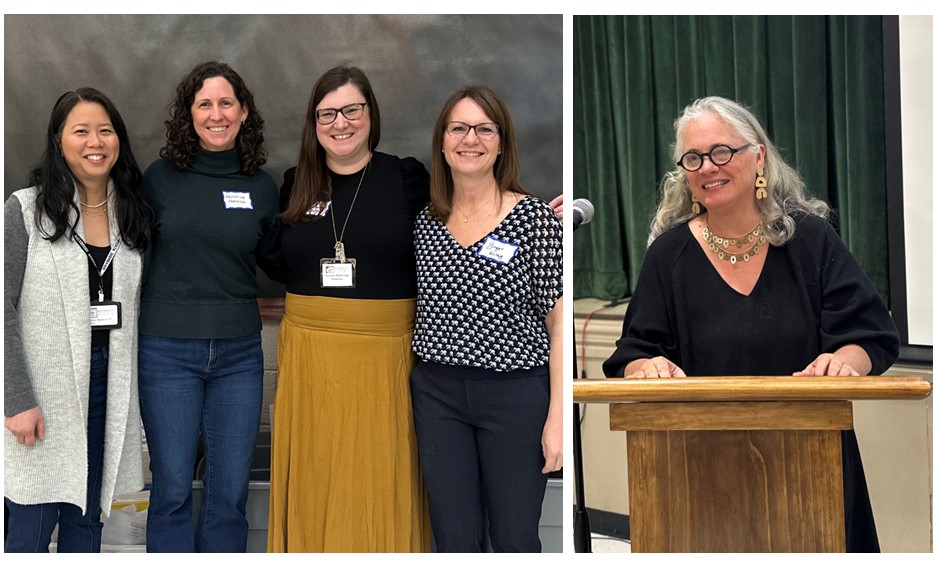
When the Trellis (Parent Volunteer Network) leadership team asked me to put together some thoughts for their kickoff, they said it was because I’ve been around for a while and have memories of volunteering during Rockbridge’s first years. My husband Rick and I were on an early iteration of the working board of Rockbridge Academy, and I well remember what it took to open the school doors each year. By the grace of God, and through the tireless work of volunteers who gave endless hours of their time to make the audacious dream of starting a classical Christian school in Anne Arundel County come to fruition, Rockbridge Academy was born.
So, what did volunteering look like in 1995 and the years following? While there were certainly lots of important things to be done—like creating budgets, filing for permits, and writing curriculum—most of my own memories of the work are of a far humbler ilk. I remember the shoulder-to-shoulder physical work that went on every August, when parents, teachers, and board members did whatever was needed to ready the classrooms for the new school year. Secondhand desks were scrubbed and repaired, curtains were sewn and hung, and floors and baseboards were scoured and polished. And so many hours were spent—standing on ladders, dabbing with little sponge brushes—painting colorful wall stencils in each classroom. (It was the 90s, so of course, we painted wall stencils!) Painted apples bordered the walls of the kindergarten, colorful Egyptian hieroglyphs ringed the second-grade room, and nearly an entire wall of the fourth-grade classroom was transformed (thanks to laboriously rendered rocks) into something that looked like a medieval fortress. To supplement this trendy painted decor, we all scavenged from thrift stores, yard sales, and our own basements to find bookshelves and clocks and art for the walls and everything else you can imagine a school, created from nothing, needed.
Books for our fledgling library had to have those little borrower’s card pockets glued into the back cover, with a corresponding 3x5 card written out by hand for our cataloging system. Black and white pictures for the bulletin boards were colored with crayons or colored pencils. Posters, signs, lists, and rosters all needed to be carefully hand-lettered. (Did you know we also hand-wrote every report card in those early years?) We, virtually the entire community, spent so much time working at the school during those early days that many of us would bring pillows and blankets for our kids so they could go to sleep under a teacher's desk when it got late. The work would quietly continue apace around them. One or two people would always have crock pots full of food plugged in so that we could take a quick break for dinner and fellowship before getting back to work.
I think back on those days now and sometimes wonder, “How was that even sustainable? Was there anything healthy about that? What on earth were we thinking? Was it all worth it?”
Was it really worth it?
As I sit down to write out these thoughts, I admit that there is some irony in how long I’ve procrastinated about pulling together a few paragraphs of ideas for a ten-minute talk, even though I was asked to do so weeks and weeks ago. My slowness to get at this particular “volunteer” task makes me recognize how often I balk at interrupting my own life these days.
The current zeitgeist consistently tells me that “me time” is to be fiercely guarded and that “boundaries” are essential to my mental well-being. And even though the Christian will recognize the incongruity of hyper-self-focus with the biblical call to die to ourselves, I don’t believe we should throw out these notions entirely. The Bible has much to say about the need for rest and quiet, after all, and the notion of boundaries can help those who are chronic over-workers set a more reasonable and well-paced cadence to their commitments.
But musing about the early days of Rockbridge—and the question “Was it worth it?”—has reinvigorated me with hope for, and delight in, the work that might be put in by this current Rockbridge community. Because, you see, my chief memories from those first years actually have very little to do with the work itself. Rather than detailed recollections of every task on our endless checklists, my memories mainly involve the people and our “life together.”
But if our scale of worth runs broader and deeper—that is, if the doing itself becomes our own participation in the slow but beautiful work of weaving the fabric of life together—then every moment we spend is, of course, “worth it.”
Life together: this is the enduring memory for me, and it’s a large part of the sustaining vision that has kept me involved in this community for nearly thirty years. Because, if Rockbridge is a mere commodity—a place aimed only at creating a product that is the best quality at the highest value—then our work will always and only be measured on an economic cost vs. benefit sort of scale, and how we feel about our work will be tied to the unpredictable vicissitudes of what the results seem to be at any particular time.
But if our scale of worth runs broader and deeper—that is, if the doing itself becomes our own participation in the slow but beautiful work of weaving the fabric of life together—then every moment we spend is, of course, “worth it.”
Of course, there’s a reason we call volunteering an “investment” of our time. We use that financial language because we rightly recognize that God has ordained a limited number of hours and days and that we should spend them with wisdom. But he does not leave us without direction about what wise stewardship of that commodity looks like, and what the reward or benefit of our task should be.
Paul says, in Philippians 2:17, “But I will rejoice even if I lose my life, pouring it out like a liquid offering to God, just like your faithful service is an offering to God. And I want all of you to share that joy.”
Do you hear the language (here paraphrased in the NLT version) that re-orients us into a better way to think about the commodity and payment relationship? While Paul acknowledges that he may quite literally lose his life, he likens that loss of life to his hearer’s willing giving of their service. He says his offering of his very life is just like their offering of their “faithful service,” and tells them he longs for them to rejoice in that pouring out to which they are called. All of this, he frames, in the preceding verses, in the light of the gospel truth: that Christ came and poured himself out—perfectly, freely—for us.
I was delighted when Mr. Griffith chose Philippians 2's theme of “Life Together” for the theme for this school year, because I’ve been chewing for some time on the notion that I’m called to “pour out” my life. The question that’s been increasingly nagging at me as I get older is simple: What is my life for, if not to be poured out?
That question, which I’d often rather not listen to, is a gentle challenge to my self-protective tendencies, but it’s counter-balanced by the earlier question I acknowledged. Is it worth it?
Philippians 2 mercifully answers that it is. “Life together” is both the business we’re to be about and the bounty we’re meant to have. It’s the call on our lives and the consequence of pouring out our lives. It’s the requirement of life in community and the reward of life in community.
Life Together is worth it, for what are we made for, if not for pouring out?
Life Together is worth it, for what are we made for, if not for pouring out?
Especially at such a time as this.
Such a time at this, when it’s tempting to look at Rockbridge as well established, with loads of paid staff and growing programs and at least some small manner of bells and whistles…
It’s tempting to sit back and glory in accomplishments and achievements, and, if we’re honest, just as tempting to grumble about deficiencies and defeats. I’m not reminding you of these temptations, by the way, without reminding myself.
But in as much as I’m admitting my own need to guard against these temptations, let me ask YOU, again, as a curative to our consumer mentality, that question I can’t get out of my head.
What is life for, if not for pouring out?
What the founders of the Trellis organization have begun to put in place is a gift for our entire community. Their vision for quantifying and filling the many needs of our “Life Together” reminds me of a grown-up version of those early hand-written “to-do” lists we had as a fledgling Rockbridge Academy. While desks may still occasionally need scrubbing if you have a willingness to do that, and while it’s possible painted wall stencils may come back into vogue (though I sincerely hope not), the breadth and vision of possibilities for service that Trellis has identified is so much broader.
With the scope of service opportunities identified by Trellis, I believe that everyone in this school has the opportunity to be woven into the richness of a life together. That life together is one of the sweetest distinctives about this place and, simultaneously, one of the chief rewards that make the work worth it. In fact, I might say, as Paul said to the Philippians: I want all of you to share in that joy.
I can’t wait to see how this vision unfolds and see how a community whose members continue to pour out their lives for one another bears witness before the watching world to the love of Christ, who didn’t hesitate to pour out His very life for us.
In all the big and small tasks that Trellis can help you discover, let's get at it together. Life together. It’s worth it.
Please reach out to the Trellis group if you're interested in sharing your gifts and coming alongside to help and support the mission and vision of the school. Reach out at: volunteer@rockbridge.org
Heidi Stevens has a long history of serving in various capacities (parent, teacher, board member) at Rockbridge Academy. She and her husband, Rick, have two daughters who are Rockbridge alumni. She joined the staff and faculty in 2000, and beginning in 2025, will serve as Rockbridge Academy's Director of Fine Arts.