Rockbridge Academy Blog
Posts Tagged "theology"
An Education of Everything: Every Square Inch, Psalm 19, and Seven Liberal Arts
October 08, 2026
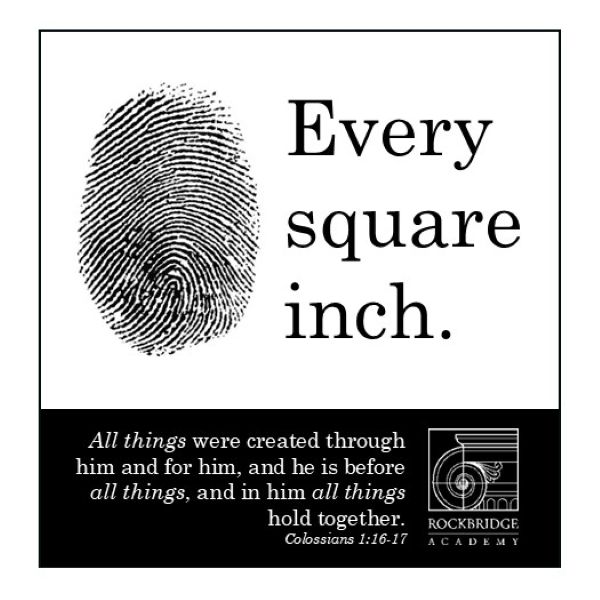
The phrase all things in the book of Colossians
makes it pretty clear. Not only has every square
inch that ever existed in creation been made by
Christ and through Christ, Jesus Christ himself – at
this very moment - holds it all together. Even within
the thin sheet of paper on which this article is
printed (or the screen from which you may be
reading these words) there is not a single atom that
Jesus Christ is not right now holding together… an
atom which otherwise would fly apart into thermo-nuclear explosion. I’m not being
dramatic. He simply holds all material and immaterial things together. It’s exhilarating to
think about, if not a little scary. He is not a tame lion.
What bearing does all this have on education? Simply this: when students enter the
classroom, the most thrilling place to be is gathered around the truths of the Lord Jesus
Christ as math, science, literature, history, logic, debate, even math facts, handwriting,
and rules of grammar come alive in the light of the one who makes them work.
The Seven Liberal Arts of a Classical Christian education are simply the best instructive
path we’ve found to make this plain to a student. Raising a child into a thinking,
compassionate, contributing adult who loves God and loves his neighbor starts with 13
years of slow, relentless, and joyful soaking in truths, habits, and ways of thinking. Day
after day, lesson after lesson, it comes clear: it is Jesus Christ who rules every square
inch of this life. This slow cultivation of loves, virtues, and devotions, are ultimately used
by the Holy Spirit to profoundly form a life as God intended. Discipling children in this
manner is truly a beautiful thing.
Every Square Inch and Psalm 19
Early in my teaching career I asked the question, how is it that these seven liberal arts,
carried forward from the Greeks and Romans by early Christendom, have proven
themselves such a powerful tool in Christian discipleship. How do they uniquely train the
student to have an “Every Square Inch” sense of reality?
Throughout the Scriptures, we find clues. If we just consider Psalm 19, for example, the
author, David, uses 14 verses of poetry to extol the entirety of God’s revelation in its two
realms: material and immaterial, general revelation and special revelation, God’s world
and God’s Word. Not only does David teach us, “ The heavens (and everything under
them) declare the glory of God,” but later in the Psalm he unpacks how, “the Law of the
Lord is perfect, reviving the soul.” In other words, if David’s categories of reality are
correct, not only do we need an education for the heavens, shorthand for every square
inch of God’s created order, we need an education that brings clarity to every jot and
tittle of His law, the logic and spiritual realities of God’s Word to His people. Enter the
Seven Liberal Arts.
Every Square Inch and the Seven Liberal Arts
Liberal Arts is a neutered term in American culture. At today’s colleges, “Liberal Arts” is
just a pejorative label put on the majors that freshmen sign up for when they know they
like to read but don’t know what they want to be when they grow up. It’s often a track of
study that gives parents hives as they daydream about Johnny’s future earning power.
Quite to the contrary, a true liberal arts education is far more comprehensive, dynamic,
and powerful.
Very simply, the Seven Liberal Arts grew out of the scholastic efforts of the Middle Ages,
capitalizing on what was so powerful within the educational models of the ancients. The
first three disciplines of the Seven Liberal Arts (known as the Trivium) include grammar
(the joyful acquisition of language), logic (the precise meaning of language), and
rhetoric (the artful use of language) giving a student mastery in the full realm of words.
Meanwhile, the final four phases of the Arts (known as the Quadrivium), unfold the
concrete realities of God’s creation through number by moving progressively from
arithmetic (number as concept), to geometry (number in space), music (number in time),
and finally to astronomy (number in space and time). Keep in mind with these titles of
the Seven Liberal Arts, we speak of phases of deepening understanding rather than
courses in a college syllabus.
By the time a student graduates a classical Christian education like we find at
Rockbridge Academy, their education gives them the tools to unfold God’s world and to
sift the realm of ideas through the scrim of His Word. If we believe David’s categories of
reality from Psalm 19, it is a framework of education equipping them with tools for the
whole of reality; an education for everything. But more importantly, as the Holy Spirit
does His work, these children will move forward into adulthood with a holy awe before
the one who commands every square inch of life… "for in Him all things hold together.”
Posted in
School Culture
To Love and Understand: The Classical Vision in Controversial Times
January 10, 2024
A decade ago, I was in my senior year at Rockbridge Academy. A lot has happened in that time, but through it the things I learned here have been a significant and treasured influence in my life. While I would be remiss not to remark on the dear mentors and close friends I made here, I want to focus this brief reflection on the vision of the world I learned from Rockbridge, with an eye to how it eventually landed me where I am now, in the theological academy.
When Nietzsche wrote that “Whoever really wishes to become acquainted with something new (whether it be a person, an event, or a book), does well to take up the matter with all possible love,” he was only repeating something that classical educators had known for millennia—that the process of learning is first a moral, and then an intellectual endeavor, or rather, that any distinction between moral and intellectual endeavors is as specious as the anthropology it undergirds is facile.
This paradigm is deeply entrenched in the Christian intellectual tradition. The Greek Fathers understood the intellect as a desiring faculty that intrinsically (if often unconsciously) sought after God and was fulfilled only in prayer; in the Latin west, Augustine’s trinitarian theology (tragically neglected by American Christians in recent years) emphasized that the very structure of the human mind pulls it towards its one end: the worship and enjoyment of God.
This is the anthropology at stake in the classical understanding of education as moral formation and within which tools like the Trivium can flourish. Its profundity is that it reflects an entire vision of the world as the theater of God’s glory. Education is formation because curiosity is a form of generosity, of hospitality towards the new and the strange; but this is merely the anthropological reflection of the objective fact that all created truth and goodness beckon us onward to the eternal wellspring that is Truth and Goodness: God—Who is Himself Love. The only light that illumines truth is the generous light of God’s creating goodness sealed in the steadfast love of redemption. And as in the archetype, so in the ectype: for Christians, to know must always mean to love.
This is the anthropology at stake in the classical understanding of education as moral formation and within which tools like the Trivium can flourish. Its profundity is that it reflects an entire vision of the world as the theater of God’s glory.
In other words, classical and Christian are not separable modifiers of education, but a cohesive way into studying the basic and unifying God-ward-ness of the world. We study the classical texts as Christians, not out of abstract adherence to a canon, but because in that canon we can inherit the practiced eye of centuries of Christians who have repeatedly and delightedly found that God’s truth, goodness, and beauty precede them there. These texts provide a fertile training ground for the virtues of wisdom, patience, and generosity required for learned cultural engagement today, indeed, for any faithful Christian walk—which is only the repeated referring all our lives to the giving and grace of God.
In other words, classical and Christian are not separable modifiers of education, but a cohesive way into studying the basic and unifying God-ward-ness of the world. We study the classical texts as Christians, not out of abstract adherence to a canon, but because in that canon we can inherit the practiced eye of centuries of Christians who have repeatedly and delightedly found that God’s truth, goodness, and beauty precede them there.
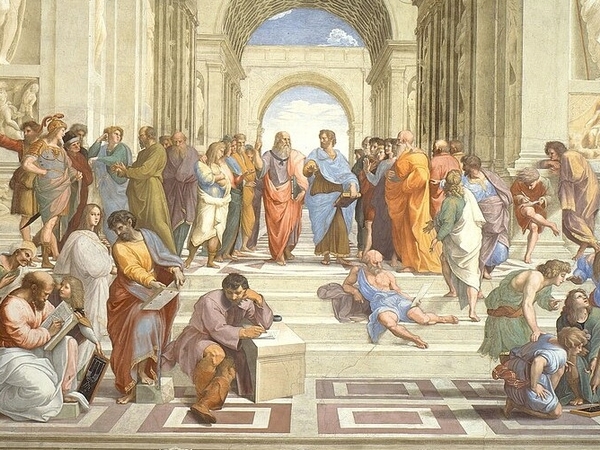
Indeed, it is those who thought that Christ and culture were most sharply opposed who likewise opposed the reliance on Greek models inherent to classical education. Conversely, Paul models the classical vision in Acts 17, in seeing that God got to Greece before him, and his job is to name the unknown God, in whom the Athenians already knew that they lived, and moved, and had their being. Similarly, the first Christian apologist, Justin Martyr, argued that Plato had dimly pointed to Christ, that Jesus was the proper fulfillment of the way of the Stoics—that it was the Christians who followed true philosophy. Christians have always most profoundly challenged the cultures around them by finding seeds of the Word and by naming Jesus Christ as the true fulfillment of those seeds.
On a personal note, these themes have been the common thread (perhaps the only one!) in my own continuing education. Studying theoretical physics at MIT, I found that a guiding intuition of much of this research was that the elegance of a theory is not just an arbitrary aesthetic value but also an indicator of the depth of penetration into the mysteries of the universe. Truth, goodness, and beauty coalesce at precisely the point where being itself becomes most transparent to the properties of its Creator.
Similarly, my study of theology at Yale, integrating as it does philosophy and cultural studies, would make little sense if one did not believe that all the activity of man’s mind is animated by the restless heart searching for rest in God, and that that search must leave its mark on all knowledge. Indeed, this most recent trajectory felt like the response to the turmoil of 2020 that would be most faithful to the vision Rockbridge has given me: to leave my stable job in finance for the life of the mind pursued in service to Christ; with the faith that commitments to justice, to generosity of interpretation, and to truth are always finally commitments to God Himself; and in confidence, alongside Paul and Justin, that the sharpest apparent conflict of worldviews opens upward in the possibility of the most incisive work of the gospel.
Similarly, my study of theology at Yale, integrating as it does philosophy and cultural studies, would make little sense if one did not believe that all the activity of man’s mind is animated by the restless heart-searching for rest in God, and that that search must leave its mark on all knowledge.
This is not to say that classical Christian education is fundamentally optimistic about human culture. Quite the opposite: if God is the proper end of all intellectual activity, then the subjects of education can be corrupted by human rebellion far more pervasively than if these studies were something morally neutral. But the conditions of this corruption are also the possibility of restoration. Evil is always parasitic, and thus only parasitic—masking an ever-prior God-ward-ness. The constructive, God-centered vision of Christian education means that “the culture” as such can never be the enemy.
The great method or technique of this ongoing discernment can only be the imitation of God’s love. If the goodness of the world stems from the generosity of God, then it is to evoke our generosity as well. Nietzsche continues: One “does well to take up the matter with all possible love, and to avert his eye quickly from all that seems hostile, objectionable, and false therein—in fact to forget such things; so that, for instance, he gives the author of a book the best start possible, and straightway, just as in a race, longs with beating heart that he may reach the goal.” If the God who is Truth is also Love, then formation in His image is the only possible pedagogy.
Taylor Craig, Rockbridge Class of 2014, is in his 3rd year of a master’s degree in Theology at Yale Divinity School, where he also works as a research assistant to Prof. Miroslav Volf. He is especially interested in trinitarian theology, early Christian interaction with Greek thought, and postmodern theologies of culture and language.
Posted in
Upper School