Rockbridge Academy Blog
Archives - March 2021
STEM at Rockbridge Academy
March 25, 2021
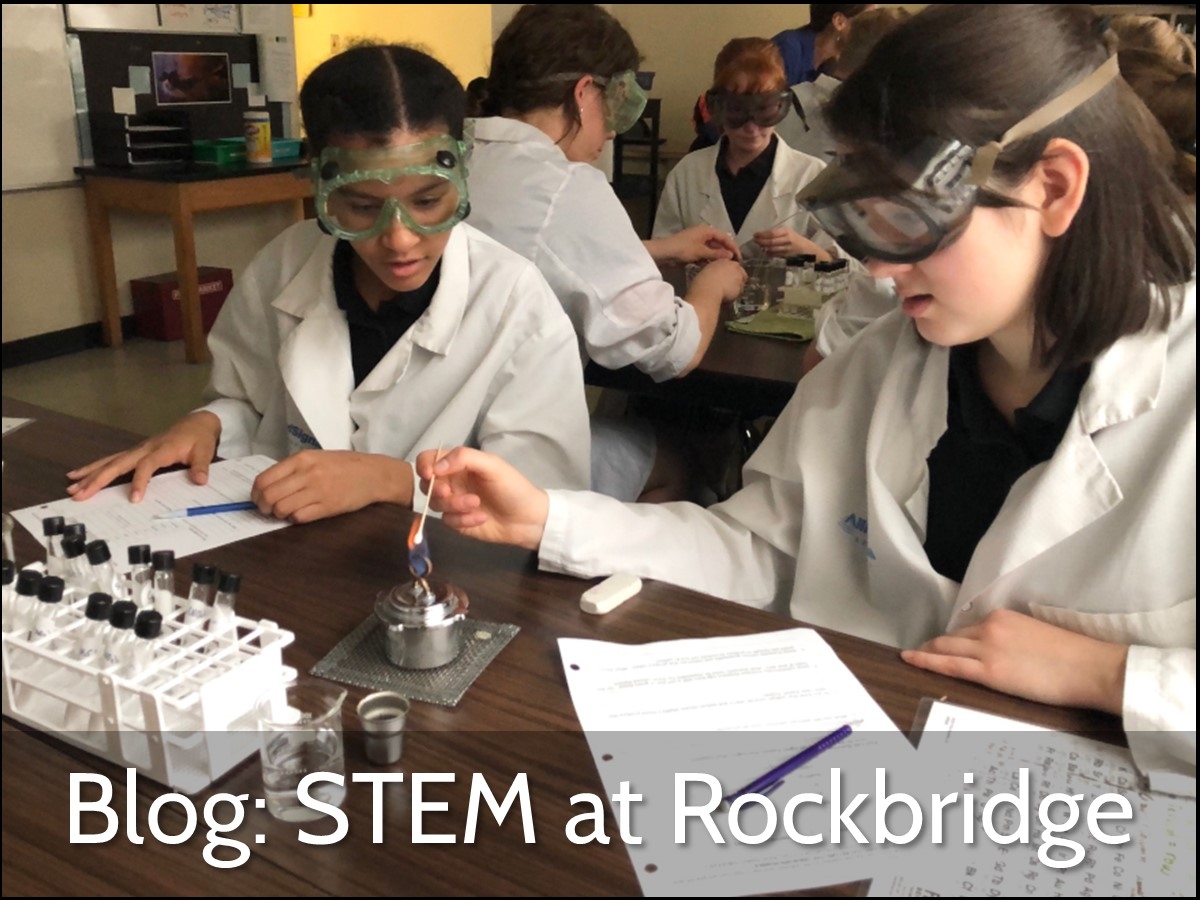
Eighth-grader Theodore Grev had a problem. Every time he camped, his sleeping hammock gave him trouble. Setting up at night in the woods, he couldn’t see to secure the knots for his tarp covering. Sometimes the tarp would blow away in the middle of the night, leaving him cold and wet.
Something had to be done.
When he saw the invitation for the Rockbridge STEM Club (Science, Technology, Engineering, and Math), Theodore decided to turn his problem into a science project. Quarantining at home during the summer COVID shutdown, he built one configuration after another, carefully recording the amount of time it took to set up each model. He finally settled on the best one: it took 8 minutes and 30 seconds to assemble and stayed up all night without fail. This winter, he entered it the Regional Science and Engineering Expo. He and his friends have also started using it on their camping trips, with great success.
Theodore is just one of several participants in the STEM Club at Rockbridge Academy.
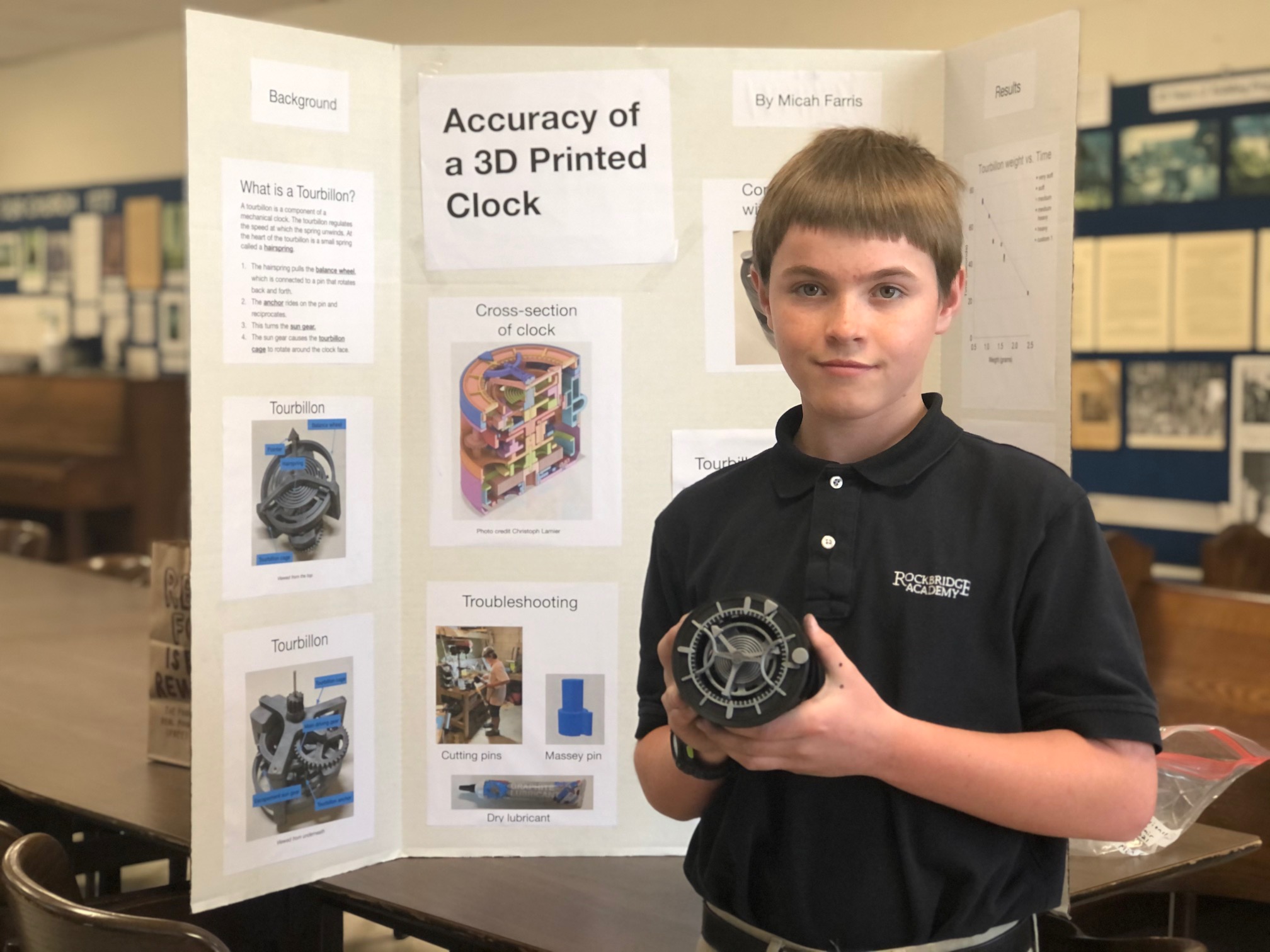
Other projects this year have included creating an accurate clock with a 3D printer; designing a walking robot; building a low-pollution cooking stove to save lives in the third world; and testing the safety of personal passwords. The club’s record is strong. Last year, freshman Josh Phillips took home 6 awards for his “Cooking Shouldn’t Kill” cookstove design. The year before that, junior Ryan McDowell took his computer security project to the Intel International Science and Engineering Fair (ISEF) and won a “Cyber Pioneer” honorable mention from the National Security Agency.
 How does this work at a classical, Christian school of only 165 middle and high school students? As STEM fields are promoted more heavily in the culture, classical, Christian schools—usually much smaller than their public counterparts—are often questioned about their ability to measure up.
At Rockbridge Academy, the curriculum includes a strong STEM track of earth science, biology, chemistry, and physics; algebra, geometry, trigonometry, and calculus; and analytical science and logic, which train students to test arguments and formulate proofs. For several years, Rockbridge students have also participated in the American Math Competition and regional and state-wide Science Olympiads, placing well in both.
The study of science and math is historically classical and Christian—grounded firmly in the liberal arts and driven by a desire to comprehend Creation. Classical educators like to quote Apple founder Steve Jobs: “Technology alone is not enough…it’s technology married with liberal arts, married with the humanities, that yields us the result that makes our hearts sing.”
“Technology alone is not enough…it’s technology married with liberal arts, married with the humanities, that yields us the result that makes our hearts sing.” Steve jobs
At Rockbridge, watching students at work DOES make the heart sing.
Cathy Phillips, a graduate of the US Naval Academy with a degree in aero engineering, started the Rockbridge STEM Club when her son Josh was entering high school. Josh had always had a scientific bent, and she wanted to provide an opportunity for students like him to pursue that bent beyond the classroom.
Mrs. Phillips sees excellence in math and the sciences as flowing naturally from a classical education, which girds students with a strong foundation in facts, then invites them to ask the “why” behind those facts—and equips them to present their findings with skill and winsomeness. She notes that classically educated students typically have a strong desire to learn and a strong background in critical thinking. This translates into excellent questions and the persevering spirit to bring their projects to completion.
This year’s participants are competing in a variety of events: the Maryland Engineering Challenge, the County Regional Science and Engineering Expo, and the Junior Science and Humanities Symposium,
Freshman Michael Grube is building a remote-controlled model cargo ship for the Maryland Engineering Challenge. He’s grappling with college-level math and nautical design, but Rockbridge has trained him in fundamental math concepts that are serving him well. Also for the Challenge, sisters Kait and Maddie Atwood are working with Sean Fitch to design and build a walking robot that walks on 2 legs over uneven terrain. And Josh Phillips created a bridge design for the “Wood Bridge Challenge” category of the competition and won first place!
Theodore Grev entered his practical hammock design in the County Regional Science and Engineering Expo. Seventh-grader Micah Farris, who has always had a bent for engineering and enjoys experimenting on his own, decided to create his own clock with a 3D printer. Both of them took 2nd place. The printing took about 100 hours, and there were long days (and nights) of assembling and disassembling the clock, testing different springs, recording the results again and again. Thankfully, he says, his training at Rockbridge had already trained him to be persistent.
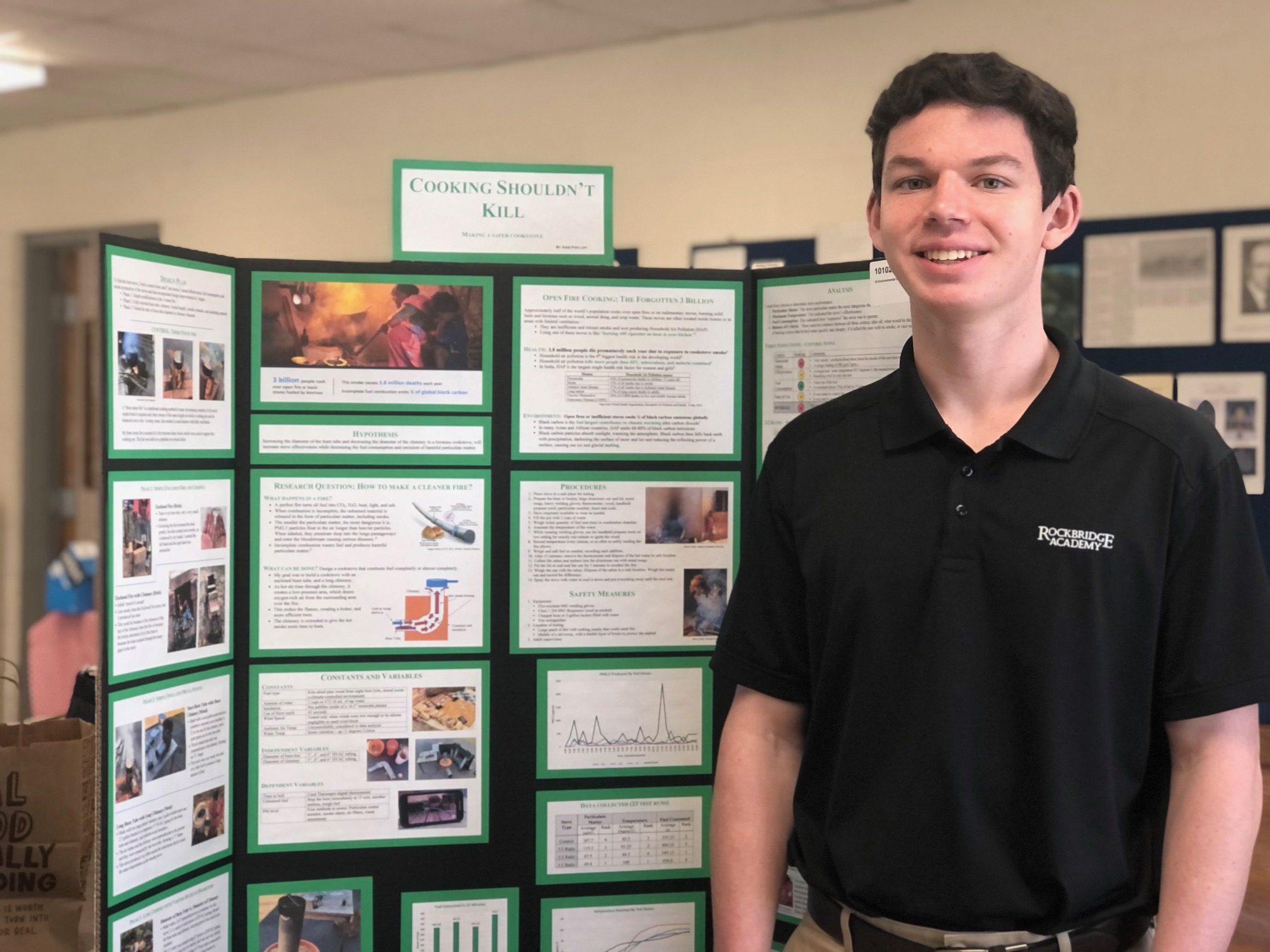 Josh Phillips, who won 6 county awards for his “Cooking Shouldn’t Kill” cookstove design last year, has improved his design and is taking it to the Junior Science and Humanities Symposium (a DOD competition) in 2021. Juniors Emma Williams and Hannah Skwarek decided to examine the effectiveness of common password security questions. After winning the approval of an Institutional Review Board, they conducted multiple interviews, collected online data from their subjects, and determined which questions offer greater security. They are off to compete on the national level.
Writing and presenting the final project for a panel of experts is a major component of all of these competitions. Yet the students consistently expressed that that was the “easy part.” At Rockbridge, they’ve been honing those skills for years.
While small classical schools may not offer a wide array of specialized math and science classes, they do offer classes that are rigorous, deep, and integrated with one another. In a STEM world that changes with blinding speed and often denies the existence of God, classical Christian education trains adept and willing learners—all while affirming the beauty of creation and greatness of the Creator. These competitions don’t just introduce students to a STEM network of friends and colleagues; they also give them opportunities to shine the light of Christ to a world that needs Him.
Posted in
Upper School
Why NOT Latin?
March 10, 2021
 At some point (or multiple points) during the school year, every Latin teacher will be asked the same question. Sometimes we encounter it at parent-teacher conferences, in the classroom, or we are asked to speak on it at back to school nights. We reach for our perfectly scripted and practiced answer that we have used time and time again when asked “why learn Latin?” This answer usually includes a list of 5 - 10 reasons ranging from the connection to English grammar and etymology, the integration with literature, history, and philosophy, and the different levels of practicality for future studies. While all of those reasons are true and valid, the reasons to study and even master Latin are far more significant and rewarding than those already mentioned. Before I go into what they are, let me point out a few things about education in today’s schools.
There is a shift happening in education. This shift is not a new one, but a slow and gradual progression spanning many decades. The progression is a movement away from education for the sake of character and well-roundedness to education for the sake of specializing and salary. The purpose of education in today’s schools is becoming increasingly utilitarian. If subject X does not directly yield a certain dollar figure in the student’s future paycheck or a tangible increase on the SAT, then the benefit of spending time and effort studying subject X is called into question.
I think it is safe to assume that those reading this article find value in the classical model of education. Classical education strives for a balance and unity of a student’s character and their functional intelligence. By equipping students with a multi-faceted and dynamic curriculum, classical education and, especially, Christian education offers students a humble appreciation for the beautiful world around us and the intellectual aptitude to grapple with it from all vantage points. Focusing on the utilitarian benefit of education alone quickly eliminates many studies and practices that have immense benefit to the formation and education of children. I'll give an example.
Most children in America grow up learning an instrument and playing a team sport. The reason for this is not, in most cases, because their parents feel confident that their children will be professional musicians or athletes one day. The reason they are enrolled in these programs is for a less utilitarian, but equally beneficial reason. Those programs equip and train children in skills that they will find rewarding in all areas of life down the road. The skills of teamwork, discipline, attention to detail, leadership, and even humble failure will not only give them greater success academically, but also socially and professionally as well.
In the same way, Latin equips students with equally important skills, not to mention that it unlocks more depth and integration with their other areas of study. Latin encourages the cultivation of indispensable character values as well as more practical, educational skills. Memorizing Latin vocabulary requires discipline and hard work. Understanding Latin grammar and parsing sentences requires logic and deductive reasoning.
Translating original Latin texts requires attention to detail, critical thinking, and the humility to continue to grapple with the text even if you fail the first several times. Going beyond these practical skills, the integration, depth, and richness that Latin offers should not be overlooked.
These values not only benefit the character of each student, but also serve to broaden and deepen their understanding of the world around them. One might ask the question though, “why not spanish or french?” While the study of any language yields immense benefits to students, Latin links us with history, art, philosophy, literature, and theology in ways that no other language can. Consider the following question.
How many parents would be impressed and would deem the education “worth it” if our students could do the following: If they could walk into the halls of Harvard and be able to read the Latin inscriptions of the walls? If they could leave their biology, pre-med, and pre-law classes with a deeper understanding because all the terminology is in a language they already know? If they could travel abroad and pick up the language easily because of their foundation in Latin? If they could read T.S. Eliot with a greater appreciation because they understand the mythological and historical references? If they could hold their own in a political or philosophical discussion because they had not only read, but translated Cicero, Livy, and Caesar? All of these examples to say, how many parents would deem their child’s education successful if their student were practically and philosophically prepared for any area of study or conversation? The utilitarian benefits of a subject have their place, but fall flat when divorced from its connection and integration with the rest of the world. The practical skills that Latin affords students as well as the part it plays in the broader conversation of western heritage make it a seamless and natural addition to the classical curriculum.
When I think about all the skills and richness that my 15+ years of studying Latin has brought to my education, all I can think in response to the question “why Latin?” is “why not Latin?”
Melissa (Caton) Lentz, ‘08, graduated Rockbridge as the first female to attend K-12. After studying English and Latin at Hillsdale College, Mel came back to teach Latin at Rockbridge for two years. She now lives in Dallas, TX with her husband, Jon, her two boys, Jackson and Calvin, and their daughter, Penelope.
Posted in
Upper School
Excellent article! I am excited to share this with others.