Rockbridge Academy Blog
Posts Tagged "lifelong learners"
Why Liberal Arts?
December 18, 2025
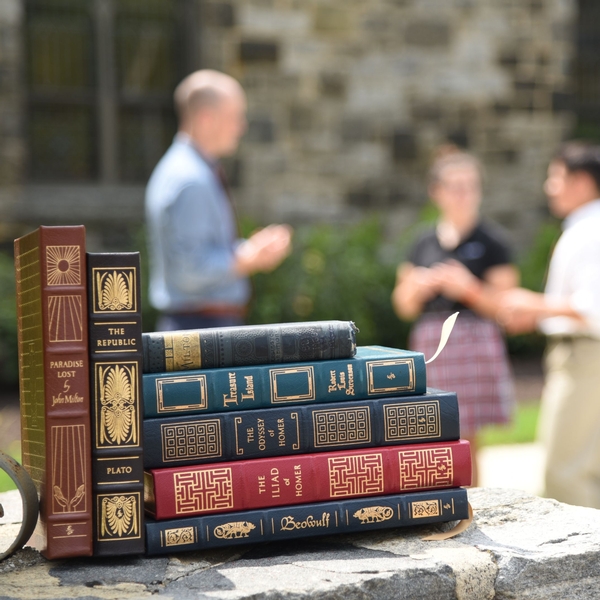
As the world grows increasingly more dependent on computers, AI, and STEM professions, the value of a well-rounded human has been forgotten by many. In STEM fields, college classes especially place the emphasis on cramming more math or science knowledge into the students’ brains, but they do not take the cultivation of the whole person into account. A liberal arts education, on the other hand, covers all fields: the humanities, social sciences, natural sciences, and arts. This form of learning equips the students with a diverse skillset. Historically, it has been composed of the trivium (grammar, dialectic, and rhetoric) and the quadrivium (geometry, arithmetic, astronomy, and music). They nurtured and cultivated the mind and spirit to understand and know. Despite many high schools and colleges discrediting the worth of a liberal arts education by not embracing them, it is still an important form of education for people in all professions. Even in my first semester in college, I’ve encountered students who are clearly brilliant, but lack the ability to interact with a historical text or carry on a deep discussion simply because they haven’t been taught that way. In any major, whether it be STEM or not, a well-rounded student needs a liberal arts education.
Even from a young age, a liberal arts education trains a student’s mind to question, interpret, and understand. By definition, it focuses on critical thinking, communication skills, and a well-rounded understanding of various fields. Once a student is equipped with tools of interpretation and critical thinking, it allows him to analyze and correctly judge the world around him more easily. If there’s a basis for how to think, it becomes easier to evaluate for ourselves what to think. It prepares a student for a life of learning and education. When applied correctly, these are skills that can be honed your entire life.
Not only does it train the mind how to think, but a liberal arts education also prepares a student for a STEM job better than a purely STEM education would. In the workforce, an employer does not just look at your GPA or your transcript, but also who you are. If you are a one-dimensional professional who only mainly understands math or science, you have a limited range of options in the workforce. However, if you can grasp the STEM concept, but also know how to communicate clearly and think on your feet, you are a much more valuable employee. Simply put, it opens a broader range of jobs. A typical science class at a non-liberal arts school gives you formulas, equations, and hands-on experience. The students greatly benefit from these classes, but schools often over emphasize the benefits of these classes, neglecting an important part of the education for what they believe is most important. Being well-spoken, articulate, and well-rounded are all benefits in a STEM field, and not necessarily something that a science class would teach.
Lastly, studying literature, rhetoric, and social sciences allows students to attain a holistic education. Every time you learn a new concept, it fits into the framework of knowledge that has already been created. This allows you to understand one subject in terms of another and make previously unseen connections, subsequently deepening your understanding of the world and God’s creation. A deeper understanding can in turn foster creativity and ingenuity in your chosen field, whether it be STEM or not. Further, if you feel like God is calling you to a different major or a different vocation than before, you don’t have to start from scratch because you already have a strong foundation and a broad education.
Liberal arts skills are basic, essential skills that everyone in every profession should learn, understand, and apply. Even in college, it is vital that you continue your liberal arts education. Learning about the humanities or how to express your thoughts concisely and clearly should not stop once you finish high school; rather, it becomes more important once you enter college or the workforce. In basic daily life, a well-rounded education allows individuals to meet the demands of a complex world, whether it be pitching a business idea, talking to a stranger, or solving a difficult engineering problem.
It is also important to recognize that a liberal arts education does not neglect the sciences. They are still an important part of the education system. Instead, it enhances the sciences. Math and science can provide us with scientific realities about the world, but they do not answer the metaphysical questions of why. Especially from a Christian perspective, studying philosophy, art, literature, and history allows us to ask and answer these questions. A liberal arts education provides an excellent, well-rounded framework that prepares you for life.
Julia Farr is a Rockbridge Academy Alumna, class of '25, studying Communications at Grove City College in Grove City, Pennsylvania.
How Firm a Kindergarten Foundation
May 26, 2022
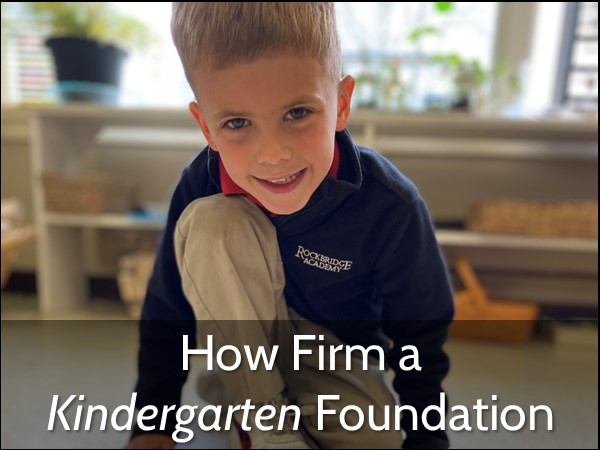
Remember playing with blocks? I don’t know about you, but as a child, I had one singular goal when stacking a tower of wooden blocks: build it as high as humanly possible! So, I stacked one block on top of another to try and reach the stars—or at least the ceiling of my living room. But despite my stacking efforts, my towers inevitably came crashing down. My young brain couldn’t quite comprehend that the key to building a solid structure was to start with a solid foundation.
Clearly, as the right foundation is key to toy tower construction, it is all the more so in regard to education. How we start has direct implications on how far and how high we can go; the foundation is critical.
At Rockbridge Academy, the groundwork of love is laid first. Knowing they are loved by God and by their teachers, each child learns to marvel at the world God has created. The foundations are set to enable them to grow in the Lord as lifelong learners.
After my childhood career of tower construction, I eventually ended up working at this school, and from my desk outside the kindergarten classrooms, I have had the pleasure of watching and listening in on all the joy and learning taking place all year long.
First and foremost, students learn more of Christ in kindergarten. Yes, they memorize Scripture (over 30 verses!) and study God’s Word in their Bible lessons, but like the red and blue lenses that make sense of 3D films, Jesus is the filter through which each lesson comes to life.
When they work on fine and gross motor skills in Motor Lab, they rejoice over how God made their bodies to move. When they study grammar, the students are reminded that the structure of our language was given by God. When they giggle through a funny book together, they are reminded of the joy we have in Christ.
A deep love of the Savior informs the way Mrs. Geverdt and Mrs. Lytikainen engage with the students. One of my favorite things about Mrs. Lytikainen is how she calls the students “Treasure.” When I asked her about it, she said it was the term of endearment she used for her own children when they were young. It falls off her tongue in the classroom because she sees each of her students as precious—to her and to the Lord.
Second, the Rockbridge kindergarten experience sets the foundation of life-long learning. As kindergarten mom, Adrienne DeGodt put it, “What we love about kindergarten is the joyful learning that’s cultivated in them. My daughter comes home ready to tell and retell what she learned in class that day. It is fun to see just how alive and vibrant everything is in her mind because of the way in which they are discovering together.”
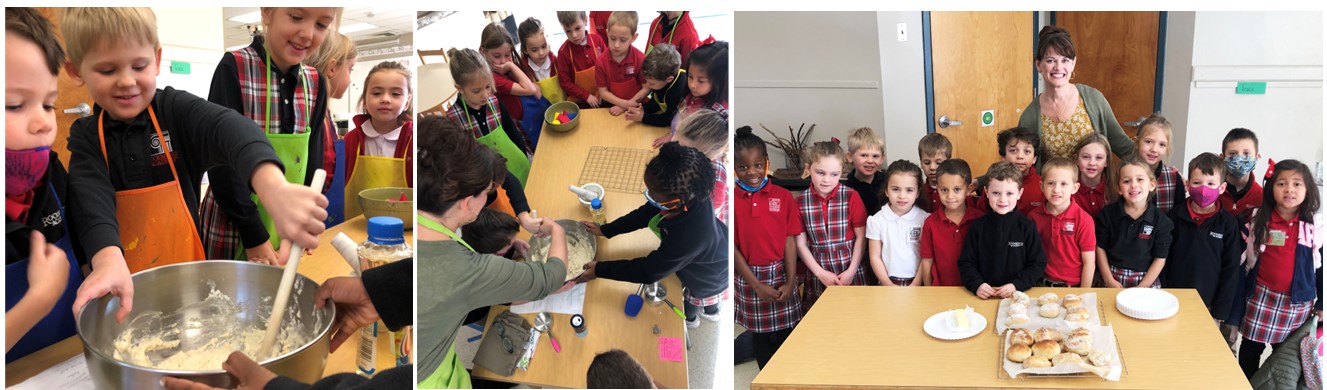
Kindergarten is a hands-on experience from day one. After talking about the rhythm of the seasons in September, the students visited a local farm and saw God’s world changing colors. After reading the story of The Little Red Hen, they went through the steps of grinding flour, mixing ingredients, and kneading dough to experience the hard work it takes to bake bread. Of course, they enjoyed the labors of their hard work, too! As spring rolled around, Mrs. Geverdt brought baby chicks into their classroom so the children could watch them grow and learn to care for them.
Daily kindergarten lessons are taught in interactive ways. Kindergarten math has recently implemented a new curriculum called Think!Math that uses the principles of Singapore Math to meet young minds where they are. Students work math problems following a CPA approach: C for concrete (holding 5 blocks in their hand and taking away 3 to feel and see that there are 2 blocks left), P for pictorial (looking at a picture of 5 blocks and imagining 3 going away to leave 2 behind), and A for Abstract (seeing the number sentence 5-3= and knowing the answer is 2). While those ideas don’t feel that different to the adult mind, they can be hugely different for a kindergartener. Adding a tactile element has helped so many little ones to conquer this challenge. This procedural understanding of math is the building block that will help them grasp division and fractions and trigonometry one day, but for kindergarten kids, it doesn’t feel burdensome. It feels like an adventure!
Finally, in Rockbridge kindergarten, students learn how to interact socially and graciously with one another, with their teachers, and with the larger Rockbridge community. Although it will be a long time before they need these skills for a college interview or to communicate with their colleagues at work, the foundations of human interactions begin in kindergarten. As tiny as they are, they learn how to put others first. They explore and express themselves, but they also learn how to respect their teachers and to listen to their classmates. For many entering students (especially this post-Covid group who missed in-person interactions for their preschool years), this is their first chance to really interact with their peers. It has been a privilege to see them blossom socially under the guidance of their teachers. The year-end Teddy Bear Serenade serves as a wonderful celebration and opportunity to put into practice all the manners and socially appropriate skills they have learned.
It would be foolish to say that only Rockbridge Academy kindergarten graduates could go on to achieve success, but I truly believe our program is the BEST start for any child’s education. It is a beautiful expression of Zechariah 4:10, which says “Do not despise these small beginnings, for the Lord rejoices to see the work begin.” Like our Heavenly Father, we rejoice to see the small beginnings of these beautiful souls and look forward to who they will become as they build on this firm foundation.
Rachel Fix works as the front desk receptionist, photography teacher, and social media specialist for the school. She has four children at Rockbridge Academy and experienced kindergarten first-hand through her own children.
Posted in
Grammar