Rockbridge Academy Blog
Posts Tagged "taking every thought captive"
An Education of Everything: Every Square Inch, Psalm 19, and Seven Liberal Arts
October 08, 2026

The phrase all things in the book of Colossians
makes it pretty clear. Not only has every square
inch that ever existed in creation been made by
Christ and through Christ, Jesus Christ himself – at
this very moment - holds it all together. Even within
the thin sheet of paper on which this article is
printed (or the screen from which you may be
reading these words) there is not a single atom that
Jesus Christ is not right now holding together… an
atom which otherwise would fly apart into thermo-nuclear explosion. I’m not being
dramatic. He simply holds all material and immaterial things together. It’s exhilarating to
think about, if not a little scary. He is not a tame lion.
What bearing does all this have on education? Simply this: when students enter the
classroom, the most thrilling place to be is gathered around the truths of the Lord Jesus
Christ as math, science, literature, history, logic, debate, even math facts, handwriting,
and rules of grammar come alive in the light of the one who makes them work.
The Seven Liberal Arts of a Classical Christian education are simply the best instructive
path we’ve found to make this plain to a student. Raising a child into a thinking,
compassionate, contributing adult who loves God and loves his neighbor starts with 13
years of slow, relentless, and joyful soaking in truths, habits, and ways of thinking. Day
after day, lesson after lesson, it comes clear: it is Jesus Christ who rules every square
inch of this life. This slow cultivation of loves, virtues, and devotions, are ultimately used
by the Holy Spirit to profoundly form a life as God intended. Discipling children in this
manner is truly a beautiful thing.
Every Square Inch and Psalm 19
Early in my teaching career I asked the question, how is it that these seven liberal arts,
carried forward from the Greeks and Romans by early Christendom, have proven
themselves such a powerful tool in Christian discipleship. How do they uniquely train the
student to have an “Every Square Inch” sense of reality?
Throughout the Scriptures, we find clues. If we just consider Psalm 19, for example, the
author, David, uses 14 verses of poetry to extol the entirety of God’s revelation in its two
realms: material and immaterial, general revelation and special revelation, God’s world
and God’s Word. Not only does David teach us, “ The heavens (and everything under
them) declare the glory of God,” but later in the Psalm he unpacks how, “the Law of the
Lord is perfect, reviving the soul.” In other words, if David’s categories of reality are
correct, not only do we need an education for the heavens, shorthand for every square
inch of God’s created order, we need an education that brings clarity to every jot and
tittle of His law, the logic and spiritual realities of God’s Word to His people. Enter the
Seven Liberal Arts.
Every Square Inch and the Seven Liberal Arts
Liberal Arts is a neutered term in American culture. At today’s colleges, “Liberal Arts” is
just a pejorative label put on the majors that freshmen sign up for when they know they
like to read but don’t know what they want to be when they grow up. It’s often a track of
study that gives parents hives as they daydream about Johnny’s future earning power.
Quite to the contrary, a true liberal arts education is far more comprehensive, dynamic,
and powerful.
Very simply, the Seven Liberal Arts grew out of the scholastic efforts of the Middle Ages,
capitalizing on what was so powerful within the educational models of the ancients. The
first three disciplines of the Seven Liberal Arts (known as the Trivium) include grammar
(the joyful acquisition of language), logic (the precise meaning of language), and
rhetoric (the artful use of language) giving a student mastery in the full realm of words.
Meanwhile, the final four phases of the Arts (known as the Quadrivium), unfold the
concrete realities of God’s creation through number by moving progressively from
arithmetic (number as concept), to geometry (number in space), music (number in time),
and finally to astronomy (number in space and time). Keep in mind with these titles of
the Seven Liberal Arts, we speak of phases of deepening understanding rather than
courses in a college syllabus.
By the time a student graduates a classical Christian education like we find at
Rockbridge Academy, their education gives them the tools to unfold God’s world and to
sift the realm of ideas through the scrim of His Word. If we believe David’s categories of
reality from Psalm 19, it is a framework of education equipping them with tools for the
whole of reality; an education for everything. But more importantly, as the Holy Spirit
does His work, these children will move forward into adulthood with a holy awe before
the one who commands every square inch of life… "for in Him all things hold together.”
Posted in
School Culture
Whimsy, Joy and Witness! The History of Rockbridge Academy PE
March 06, 2025
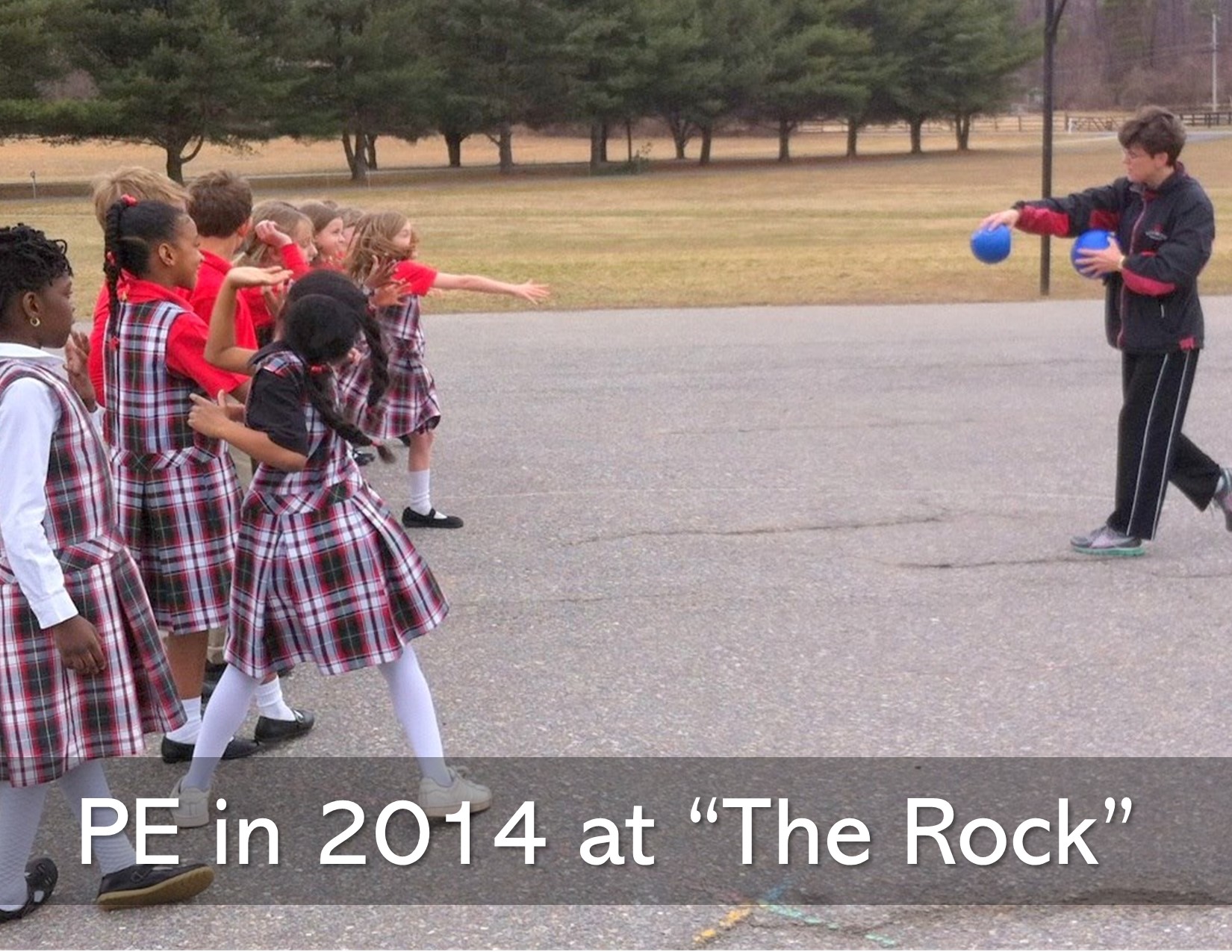 “We would do it differently, or it wouldn’t be worth doing.” That was the attitude that permeated every effort and initiative of Rockbridge Academy’s founding families. This included PE—physical education. The phrase is almost redundant, as if education itself is ever apart from the body. Certainly that was the understanding of our founding families, who determined to provide an integrated education, a classical, christian education which would affirm Colossians 1:17: that all of life was created through Christ and is held together and sustained by Him.
The Scriptures are rife with analogies of the how the body informs the mind and vice versa (Mark 12:30, Prov. 3:7-8, James 3:2, to list a few). In a fallen world that continually tries to dis-integrate what God has integrated, it may seem radical to affirm, as the vision for Rockbridge PE does, that, “God is Sovereign to mysteriously work in the physical world and produce spiritual results. This is most evident in the physical death of the God-man, incarnate to bring about spiritual redemption and new life. Since God has seen fit to integrate the material and the immaterial, the visible and the invisible, we should strive to teach our children that God is glorified in how they use their bodies, as well as their minds and spirits.”
God is glorified when we are good stewards of our physical bodies. In a classical and Christ-centered school, children should be taught how to move skillfully, how to play strategically, and how to exercise consistently and expressively. Our goal in physically educating our children should be that they would be like David, the poet-warrior, who ‘danced before the Lord with all his might’” (II Sam. 6:14).
A little further along in our PE curriculum it reads, “According to the Westminster Catechism, ‘The chief end of man is to glorify God and enjoy Him forever.’ This enjoyment includes physical pleasures such as rolling down a grassy hill, running an invigorating five miles, playing a game of tag, or walking as a family after dinner, all while caring for all aspects of the body. God is glorified when we are good stewards of our physical bodies. In a classical and Christ-centered school, children should be taught how to move skillfully, how to play strategically, and how to exercise consistently and expressively. Our goal in physically educating our children should be that they would be like David, the poet-warrior, who ‘danced before the Lord with all his might’” (II Sam. 6:14).
Did you catch that? These words are written in Rockbridge Academy’s PE curriculum? Reading over these pages again recently, I was reminded of the beautiful vision that was set before me 21 years ago, when Donna Griffith, co-author of this curriculum, PE teacher at the time, and Rockbridge Academy's first Athletic Director, invited me to apply to teach PE at Rockbridge. In that moment, I had no idea how God would use me, only that I was being invited to participate in a distinctive, counter-cultural movement called, “Classical Christian Education,” and one that I had already decided I wanted for my own children.
Donna Griffith mentored me in those days, along with Amy Marshall (who was recognized in the last Benedictio for reaching her 25-year milestone at Rockbridge). Donna’s background and training was in PE, and she had been a college athlete, so when she envisioned PE and athletics from a godly perspective, she knew exactly what they would be distinguished from. PE at Rockbridge would be taught from the Trivium—those three particular stages of development that align so clearly with the growth and development of each child. Her description reads, “Physical Education in the Grammar school helps students become proficient in basic movement skills. In Dialectic, the children refine the skills learned in grammar school and apply them while playing a variety of individual, dual, and team sports. Students also receive instruction in strategies and rules. In Rhetoric, the students continue perfecting their skills in a variety of sports while learning about strategy.” In a recent phone call, Donna recollected that, “This idea was very unique to our school, [the idea that] the playing field is to PE what the chemistry lab is to chemistry.” Children’s knowledge and understanding are used to put on a beautiful display—whether that is exploration and discovery in a lab, in making music or art, in giving a thesis speech, or playing in an athletic competition. Donna went even further in describing this vision as “whimsical,” the desire for our children to have “beautiful coordination” and “majestic and lovely” movement. Whimsy? Yes, of course! When our children fully realize a godly vision in any endeavor, it brings joy—whimsy—the foretaste of Heaven.
Amy Marshall, who taught upper school PE for several years in those early days, may have had this notion in mind when she decided to teach her students ballroom dancing! Most of what she remembers from teaching in those early years was that, “We were aiming at skills acquisition, training men and women according to their frame, being earnest about shaping our 'earthen vessel' to serve God well, and so on.” But it was the ballroom dancing unit that quickly spilled over from her PE students to the rest of the student body. Soon non-PE upper school students were streaming into the gym. Ballroom dancing gave way to swing dancing, and learning that ultimately led to a performance in the Rockbridge Academy Variety Show. And it started with the fun, the delight, of movement in PE class!
If you have read this far, I hope you are encouraged, even inspired by the vision that informs your child’s physical education and athletic participation at Rockbridge Academy. But, I would be remiss if I didn’t elaborate on one additional distinctive. Our PE vision goes on to say that, “Physical education is unique in the opportunities it provides for character development. Physical activities and competition often trigger emotions that aren’t exhibited in the classroom.”
Physical education is unique in the opportunities it provides for character development. Physical activities and competition often trigger emotions that aren’t exhibited in the classroom.
That description sounds a lot like an idea often attributed to Plato suggesting that, "You can discover more about a person in an hour of play than in a year of conversation.” (You can google the quote later for an interesting read on its disputed origin, but I think the essence of the meaning has been accurately preserved.) I can affirm this sentiment from first-hand experience! A game of dodgeball—or basketball, or soccer, or tag or "Sharks and Minnows”—brings out emotions seldom seen during a spelling test or classroom discussion.
So that, “The physical educator has the privilege of teaching the children what God has to say about their emotions and how they should respond to those emotions. The goal of the classical and Christ¬ centered physical education program is to have students exhibit self-control and humility as they play to the best of their God-given ability.”
The goal of the classical and Christ-centered physical education program is to have students exhibit self-control and humility as they play to the best of their God-given ability.
This kind of training, this shaping of character, becomes evangelistic. Our athletic handbook states, “While winning is valued, at Rockbridge Academy, the overriding emphasis is on building the Christian character of our student athletes…Sportsmanship, teamwork, fair play, and the value of hard work are valuable life lessons that can be learned through competitive athletic participation. [Athletic] games afford an opportunity for Rockbridge athletes to act as ambassadors for Christ..[to] show respect and appreciation for our opponents, officials, and coaches.” Of course, for, “We are therefore Christ’s ambassadors, as though God were making His appeal through us.” 2 Cor. 5:20. This is always our first and most important objective as Christians in any endeavor we pursue.
Sportsmanship, teamwork, fair play, and the value of hard work are valuable life lessons that can be learned through competitive athletic participation. [Athletic] games afford an opportunity for Rockbridge athletes to act as ambassadors for Christ...[to] show respect and appreciation for our opponents, officials, and coaches.
Where this vision takes hold of each student, and is brought to fruition by the Holy Spirit, our graduates, whether in a professional stadium, in a collegiate competition, on the neighborhood pickle ball court, or any other area of play, will look very different indeed. Ok, let’s play!
Melanie Kaiss has taught PE at Rockbridge Academy since 2004. She began teaching when her oldest child was in second grade. All four of her children have since graduated from Rockbridge (Classes of 2015, 2016, 2018, and 2024). Over the last 21 years, Melanie has taught PE at every grade level, been assistant to the Athletic Director, coached girls soccer and lacrosse, and run numerous Discovery Summer camps for five years running. Melanie’s husband, Stephen, joined the Rockbridge board shortly after she began teaching. He became a permanent board member and continues to serve today.
A Part of Our Rockbridge DNA: A Reflection on Faculty Morning Prayer
October 10, 2024
As students come into the building each morning, they hear a strange sound echoing throughout the hallways. It's an unfamiliar sound in schools and buildings to be happening at 7:30 in the morning: sometimes louder, sometimes softer, and sometimes a higher or lower pitch. And then it abruptly stops about three minutes later. The sound comes from Mrs. Kennedy's Physics classroom. But the students hear it every day, so they no longer raise their eyebrows and ears to figure out what it is. It's completely normal to them.
What the students hear each morning is the sound of their teachers singing a hymn a cappella. Since the door is left ajar, the sound travels. From the entrance of the school, you can just make out murmurs set to pitch; as students walk further into the building, the words become more recognizable. School hasn't started yet, so students are unloading book bags and already nibbling away at their lunches, casually hanging out with friends with heels up on their locker doors. To them, hearing adult men and women singing full voice is not strange to them. It's just what their teachers do.
#87: Holy, Holy, Holy, Lord God Almighty! / Early in the morning our song shall rise to thee; / Holy, Holy, Holy, merciful and mighty! / God in three Persons, blessed Trinity!
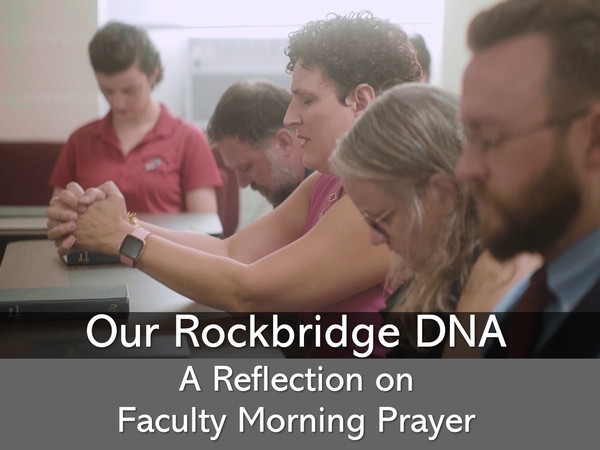
Each morning the Rockbridge faculty and staff gather together to sing a hymn and pray together for our students, families, and alumni. This is absolutely one of my favorite things we do. Here's how we do it.
When the bell rings at 7:30, someone picks out a number from a blue Trinity Hymnal. We've all picked one up from a bookrack as we've entered, so we're ready. It's a bonus when we're accompanied by a piano or a flute, but we're normally a cappella. Some of us try to sing harmonies—others succeed. And if it’s one of those hymns with the extra verses written beneath the final music staff, we sing all the extras too.
The collection of blue Trinity Hymnals with a solitary gold cross on the front have been gifted to us from various churches as they have updated to the newer red hymnals of the same design. Inside the front cover are stamps of the names of the donating churches. That our hymnals which allow us to sing together do not all come from one church but from several reminds me of the fellowship of families which belong to a myriad of church congregations and denominations but come together to form one Rockbridge. The Trinity Hymnal has been a new hymnal to me, but it has nearly all of my favorites.
#122: O ye heights of heav'n, adore him; / Angel hosts, his praises sing; / All dominions, bow before him, / And extol our God and King.
That our hymnals which allow us to sing together do not all come from one church but from several reminds me of the fellowship of families which belong to a myriad of church congregations and denominations but come together to form one Rockbridge.
After singing, we pray for current Rockbridge families and for alumni, selecting about five or six families each day. There's even a binder labeled "STAFF MORNING PRAYER LIST" to make sure we don't miss anyone, moving alphabetically through a roster of family names throughout the year. If you are an alumni, please know that we still pray for you by name. Your teachers delight in remembering you. For current families, please know that we pray for your entire household by name. As an Upper School teacher, praying for Grammar School students is how I have come to know the students who will one day be in my classroom.
If you are an alumni, please know that we still pray for you by name. Your teachers delight in remembering you.
We also take prayer requests for the faculty and staff for the day. It is here that we have shared in some of the greatest joys in each other's lives while also lamenting the greatest of sorrows. In a way, to pray for someone is to truly know them because it is to properly see them, their joy, or their sorrow in relation to God's ever-present care. Similarly, to be prayed for is to be known. It has meant so much to me on the days when I have asked my colleagues to pray with and for me.
It is here that we have shared in some of the greatest joys in each other's lives while also lamenting the greatest of sorrows.
The hymn, the prayer requests, the fellowship of prayer. This all happens in about ten minutes. And I'm so glad it does. It would be so natural to start the day together but to do so merely for the sake of making announcements and reminders about the day. And while we do sometimes have those, the focus is on preparing our hearts for the people and the learning of that day. As the school begins to be filled with students, it is also filled with prayer asking God to guide, to protect, to nurture our students.
I wanted to know when this rhythm began and how it had evolved, so I went about asking those teachers who were starting school days fifteen, twenty, or twenty-nine (!) years ago. All of them said the same thing: it’s one of those things that everyone remembers doing but doesn’t remember when or how it started. It struck me that singing to God and praying to him are just a part of the DNA of Rockbridge. Just as we don't remember learning to brush our teeth or how to tie a knot, at Rockbridge we sing to God and pray to him because it is part of the fabric of who we are.
#492: Take my voice, and let me sing, / Always, only, for my King. / Take my lips, and let them be / Filled with messages from thee.
It struck me that singing to God and praying to him are just a part of the DNA of Rockbridge. Just as we don't remember learning to brush our teeth or how to tie a knot, at Rockbridge we sing to God and pray to him because it is part of the fabric of who we are.
Posted in
School Culture
On War Stories
November 29, 2023
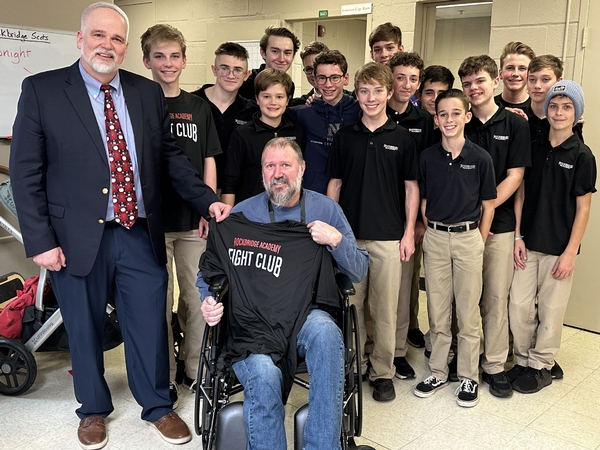
This article was written in March 2020 by Nathan Northup, Rockbridge Academy Bible teacher. He went to be with the Lord on November 2, 2023. His legacy will live on through the hundreds of people he loved, served, and counseled, both in his ministry to the church and in the Rockbridge community.
“Kick in the gates of hell! I’ll see you on the other side!” is the charge I imagine a great military commander bellowing out to his troops as they storm forward with swords raised high to take captive the great fortified city: Death. The Lord Jesus Christ said that the gates of Hades (death) will not prevail over His Church. As Christians, we know that we have been delivered from the dominion of sin and death and into the glorious kingdom of our Lord and thus enlisted as soldiers in the great battle, not against flesh and blood but against the principalities in the heavenly places.
In particular, here at Rockbridge Academy, our very motto is to TAKE EVERY THOUGHT CAPTIVE and make it obedient to Christ Jesus. The principle is clear throughout the Christian Scriptures that WORSHIP IS WARFARE when we consider all the oddly warlike language used to describe our journey. Every baptism, prayer, song, sermon, sharing in the body and blood of Christ, hearty joyful giving is an act of war. This war is waged with faith, hope, and love. We’ve been given weapons for offense and elements for defense. We desire that God destroy all of His and our enemies by capturing their hearts and adopting them into His family, enlisting them in His army, converting them to change their allegiances. We pray and preach and praise to this end. So then, when we gather as God’s New Covenant people for corporate worship, we have drawn our battle lines, and we go to war. All who are in this battle were once on the other side of the field and were graciously conquered by our triumphant King who leads us in His glorious procession.
This is why, every Monday in the Dialectic Bible classes, I ask for war stories. These war stories are testimonies of what God was doing in their life during the battle in the previous Lord’s Day corporate worship. Most of the time, the students testify to the Word of God given by their pastors, but we also hear stories of baptisms, confirmations, first communions, missionary testimonies, and more. I will sometimes jest that very rarely, if ever, have I had someone come back from the battle and testify to what a great encounter they had with the only true and Triune God during the tithes and offering portion of the service.
When all is said and done, I desire for my students to see the hand of God working in their midst and to rejoice in what He is doing as He works through them to destroy evil in our lives and the world around us. When we head off to worship Christ our King, let us kick in the gates of Hell so that when we have overcome on that great Day, we can look back across the battlefield and raise our swords and glasses to the One who has overcome and trampled down death by death giving us His very life that we may conquer and live with Him!
When all is said and done, I desire for my students to see the hand of God working in their midst and to rejoice in what He is doing as He works through them to destroy evil in our lives and the world around us.
Posted in
Worship