Rockbridge Academy Blog
Posts Tagged "liberal arts"
Why Liberal Arts?
December 18, 2025
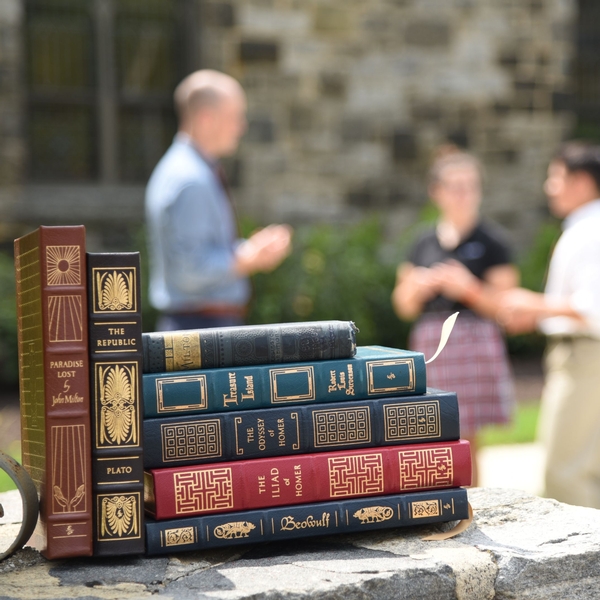
As the world grows increasingly more dependent on computers, AI, and STEM professions, the value of a well-rounded human has been forgotten by many. In STEM fields, college classes especially place the emphasis on cramming more math or science knowledge into the students’ brains, but they do not take the cultivation of the whole person into account. A liberal arts education, on the other hand, covers all fields: the humanities, social sciences, natural sciences, and arts. This form of learning equips the students with a diverse skillset. Historically, it has been composed of the trivium (grammar, dialectic, and rhetoric) and the quadrivium (geometry, arithmetic, astronomy, and music). They nurtured and cultivated the mind and spirit to understand and know. Despite many high schools and colleges discrediting the worth of a liberal arts education by not embracing them, it is still an important form of education for people in all professions. Even in my first semester in college, I’ve encountered students who are clearly brilliant, but lack the ability to interact with a historical text or carry on a deep discussion simply because they haven’t been taught that way. In any major, whether it be STEM or not, a well-rounded student needs a liberal arts education.
Even from a young age, a liberal arts education trains a student’s mind to question, interpret, and understand. By definition, it focuses on critical thinking, communication skills, and a well-rounded understanding of various fields. Once a student is equipped with tools of interpretation and critical thinking, it allows him to analyze and correctly judge the world around him more easily. If there’s a basis for how to think, it becomes easier to evaluate for ourselves what to think. It prepares a student for a life of learning and education. When applied correctly, these are skills that can be honed your entire life.
Not only does it train the mind how to think, but a liberal arts education also prepares a student for a STEM job better than a purely STEM education would. In the workforce, an employer does not just look at your GPA or your transcript, but also who you are. If you are a one-dimensional professional who only mainly understands math or science, you have a limited range of options in the workforce. However, if you can grasp the STEM concept, but also know how to communicate clearly and think on your feet, you are a much more valuable employee. Simply put, it opens a broader range of jobs. A typical science class at a non-liberal arts school gives you formulas, equations, and hands-on experience. The students greatly benefit from these classes, but schools often over emphasize the benefits of these classes, neglecting an important part of the education for what they believe is most important. Being well-spoken, articulate, and well-rounded are all benefits in a STEM field, and not necessarily something that a science class would teach.
Lastly, studying literature, rhetoric, and social sciences allows students to attain a holistic education. Every time you learn a new concept, it fits into the framework of knowledge that has already been created. This allows you to understand one subject in terms of another and make previously unseen connections, subsequently deepening your understanding of the world and God’s creation. A deeper understanding can in turn foster creativity and ingenuity in your chosen field, whether it be STEM or not. Further, if you feel like God is calling you to a different major or a different vocation than before, you don’t have to start from scratch because you already have a strong foundation and a broad education.
Liberal arts skills are basic, essential skills that everyone in every profession should learn, understand, and apply. Even in college, it is vital that you continue your liberal arts education. Learning about the humanities or how to express your thoughts concisely and clearly should not stop once you finish high school; rather, it becomes more important once you enter college or the workforce. In basic daily life, a well-rounded education allows individuals to meet the demands of a complex world, whether it be pitching a business idea, talking to a stranger, or solving a difficult engineering problem.
It is also important to recognize that a liberal arts education does not neglect the sciences. They are still an important part of the education system. Instead, it enhances the sciences. Math and science can provide us with scientific realities about the world, but they do not answer the metaphysical questions of why. Especially from a Christian perspective, studying philosophy, art, literature, and history allows us to ask and answer these questions. A liberal arts education provides an excellent, well-rounded framework that prepares you for life.
Julia Farr is a Rockbridge Academy Alumna, class of '25, studying Communications at Grove City College in Grove City, Pennsylvania.
Three Lessons from the Thesis Process
April 12, 2022

When people asked me “What do you teach?”, I would sometimes say, “A research, writing, and speech class for juniors and seniors. It’s called ‘rhetoric.’” But it is more than that: rhetoric is a capstone of a liberal arts education, and success is measured less in information or skills students acquire (research, writing, speech) than in the kind of people students become. Don’t misunderstand me—we cover a lot of information in rhetoric, from the sonnet structure to the power of MLK Jr.’s “Letter from Birmingham Jail”. . . . But the core of a liberal arts education is for students to become self-disciplined, independent learners who can serve the world with their wisdom. The junior and senior thesis projects are opportunities for students to do just that.
First, the thesis is an exercise in self-discipline. The final product does not come about in a day’s work. Students must determine a worthwhile topic, develop a feasible research question, track down trusted resources, understand experts on all sides, glean pertinent evidence, develop their own ideas, organize their thoughts into an outline, articulate their argument in clear writing, turn their written argument into a compelling speech, present their argument before an audience, and answer that audience’s questions. Don’t worry—we lay out many, many checkpoints, with feedback and instruction along the way. But the ability to accomplish such a project takes practice (part of the reason for including both a junior and a senior thesis in the curriculum), and students who try to track down the necessary sources the night before the note cards are due learn the pain of procrastination.
Second, the thesis is an exercise in independent study. I frequently tell my students that my goal is to work myself out of a job, meaning that I want them to no longer need a teacher in order to learn whatever they want. Students of a liberal arts education should be prepared to tackle the topics that come their way, and the thesis projects are an opportunity for students to put their ability to the test. From nuclear energy to separation of church and state, from embryonic stem-cell research to the value of fairy tales, the thesis topics are as varied as the students’ interests. The thesis shows they have the skills to be lifelong learners, coming to biblically-grounded conclusions with less and less direction from a teacher.
Finally, the thesis is an exercise in sharing ideas with an audience. Over the years, I have been inspired by lines from Rudyard Kipling’s poem “IF”: “If you can talk with crowds and keep your virtue, / Or walk with Kings—nor lose the common touch, . . . / Yours is the Earth and everything that’s in it, / And—which is more—you’ll be a Man, my son!” I want my students to be able to speak before both kings and commoners with virtue and clarity. The Apostle Paul gives a biblical model of this in his own ministry and charges us in Ephesians 4 to use our skills to build up the body of Christ. I know I have been built up by listening to many thesis presentations from my students. They have done the hard work of thinking and writing, and at the end of the year they have shared their work with others through public presentations.
The rhetoric work of Rockbridge students has frequently reached a wider audience through speech competitions such as the Rotary Club 4-Way Test speech competition, the VFW Voice of Democracy competition, and the Association of Classical Christian Schools Chrysostom Oratory competition. These audiences have recognized the excellence of our students’ work on a state and national level. Many students, though, celebrate triumphs that never gain accolades at award ceremonies—persevering through an apparent dead-end in research, finding the perfect phrasing for a sentence, and learning to listen to classmates who disagree and to seek biblical unity on difficult issues.
In his small book The Idea of a Christian College, Arthur F. Holmes captures part of my aim in teaching: “To teach a person to read and to write is to teach him to think for himself, to develop more fully the possession of his God-given powers” (p. 31). In some sense, I am still teaching students to read and write. They are simply reading academic journals and writing a 20-page persuasive essay. But in response to “What do you teach?” maybe I should say, “I am helping students develop their God-given powers,” and I’ve found the thesis to be a helpful tool towards that end.
Emily Scheie is a teacher who is grateful to share the joy of learning with her students. Outside the classroom, you might find her coaching cross country, taking graduate classes in linguistics, or reading for book club (with a mug of tea in hand). She is a sister to six siblings and three siblings-in-law and is an aunt to a growing number of nieces and nephews. She worships and serves with Redeemer Anglican Church in Annapolis and believes, in the words of the poet Gerard Manley Hopkins, “The world is charged with the grandeur of God.”
Posted in
Upper School